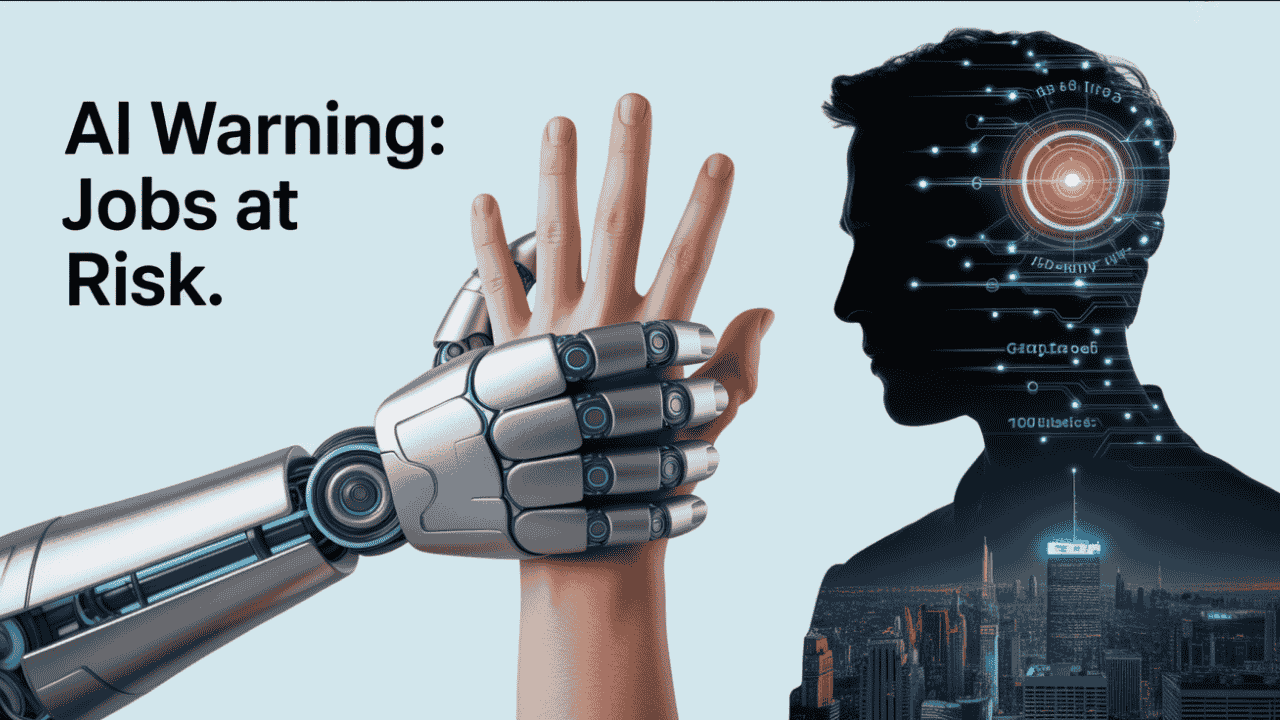
AI and Jobs: The Godfather’s Warning About Our Future?
Imagine this for a second… You wake up, get dressed, head to the office—same routine as always. But when you sit down at your desk, something feels off. Your manager calls you in, and with a cold look says: “I’m sorry… but we don’t need you anymore. We’ve found someone who can do your job faster, cheaper, and without mistakes.”
Would your company still keep you?
Now imagine that replacement isn’t even a human being. Imagine it’s a machine—one that doesn’t get tired, doesn’t ask for sick leave, doesn’t care about overtime, and has no emotions. Scary, right? This isn’t a scene from a sci-fi movie. It’s happening right now. Across the world, millions of workers are being silently replaced. And the man who warned us first? The one scientists call the Godfather of AI—Geoffrey Hinton.
The Birth of Artificial Intelligence
Artificial Intelligence, or AI, didn’t just pop out of nowhere in the last couple of years. The idea goes back decades. In fact, all the way back in 1950, British mathematician and computer scientist Alan Turing asked the question: “Can machines think?” To test that, he came up with something called the Turing Test. The idea was simple but genius: if a human talks to a computer and can’t tell whether the responses are from a person or a machine, then the computer has passed the test. For decades, no machine could pass it. Until… 2014.
That year, at the Royal Society in London, judges interacted with what they thought was a 13-year-old Ukrainian boy. The answers were clever, funny, even a bit unpredictable—just like a real teenager. Out of 30 judges, 20 were fooled. They thought it was a human. But it wasn’t. It was a chatbot named Eugene Goostman. The world realized: the age of AI had truly arrived.
Geoffrey Hinton, The Godfather of AI.

So who exactly is Geoffrey Hinton? For nearly 10 years, he worked at Google, building the foundations of modern AI—things like neural networks and deep learning. His work wasn’t just academic. It’s the reason why today’s AI models like ChatGPT, Gemini, and Claude even exist. In fact, Hinton trained some of the biggest names in AI today: Yann LeCun (Meta’s Chief AI Scientist) and Yoshua Bengio. Together, these three pioneers won the 2018 Turing Award—basically the Nobel Prize of computer science. But then, something shocking happened. In 2023, Hinton suddenly quit Google. Why? Because he realized the technology he helped create might not just help humanity… it could actually replace us. He warned: “Human intelligence has already slipped to second place. Number one now belongs to AI.”
The Coming Job Apocalypse:
Now, here’s where things get really unsettling. Hinton believes AI is about to eat entire professions. Not just one or two jobs—whole industries. Let’s break it down.
1. Customer Support Agents

The very first victims? Call center workers. Think about it. When you call your bank or your phone company, are you really talking to a person anymore? Chances are, you’re already talking to AI. Take the company Klarna, for example. Their CEO admitted that a single AI chatbot is now doing the work of 700 agents. As a result, they went from employing 7,000 people in customer service… down to just 3,000. That’s 4,000 jobs—gone—almost overnight. And here’s the kicker: AI doesn’t get frustrated, doesn’t need a lunch break, and answers instantly. Today, over 80% of customer support tasks are handled by AI. So if you work in a call center, you’re officially in the danger zone.
2. Lawyers and Legal Assistants

You’d think law would be safe, right? Nope. Junior lawyers and paralegals are already being replaced. Why? Because AI can now summarize court cases, draft contracts, and do legal research—10 times faster than a human. Tools like Harvey AI and GPT-4 are already being used by top law firms. Work that used to take a junior lawyer 3 days… AI finishes in 30 seconds. With references, citations, and past case law—all neatly packaged. That means law firms are asking: Why hire a junior associate when an AI can do the same job instantly?
3. Writers and Content Creators

Here’s the one nobody wanted to hear. Writers—journalists, bloggers, copywriters—are all under threat. Even Google’s own blogging platform, Blogspot, has seen its traffic collapse because AI tools can now generate endless articles. And unlike humans, AI doesn’t need inspiration, sleep, or coffee. Today’s writers are being replaced by a new kind of worker: prompt engineers—people who just tell AI what to write. But Hinton warns even that job is temporary. Because one day, AI will start writing its own prompts.
4. Fresh Graduates

This one hits hard. Entry-level jobs—the stepping stones for young graduates—are disappearing. Data entry, customer onboarding, document verification, email responses… all handled by bots. A silent crisis is unfolding. Students graduate with degrees but find there’s no “starter job” left to build a career.
5. Software Developers

For years, coding was seen as “future-proof.” But not anymore. AI tools like GitHub Copilot and Replit AI already write and debug code. A person with zero coding skills can now just type a request—and boom—a website is built in minutes. Developers are slowly being reduced to “debugging assistants.” And once AI learns to rewrite and modify its own code? Human developers might not be needed at all.
6. Doctors and Healthcare

Now, don’t panic—AI isn’t replacing doctors yet. But it’s making them 5 times more efficient. One doctor who used to see 10 patients a day can now see 50—with the help of an AI assistant that diagnoses symptoms, checks medical history, and even drafts reports. That means fewer new doctors being hired. Junior doctors and diagnostic specialists are already feeling the squeeze.
7. The Creative Industry

This one’s brutal. Designers, video editors, musicians, animators—all in danger. Why? Because AI doesn’t just copy creativity—it invents new forms of it. Hinton explains that AI can connect ideas humans never would. Imagine combining the style of Picasso with the rhythm of hip-hop—AI can create that instantly. Humans might take years to even think of it.
8. Analysts and Knowledge Workers

Data analysts, researchers, Excel wizards—your jobs are on the line too. A human brain has limits. AI doesn’t. It can scan millions of records in seconds, find patterns we’d never see, and summarize everything instantly. In short: if your job is just “thinking and reporting,” AI is already doing it better.
Jobs That Are (For Now) Safe
Now, before you get too depressed, let’s talk about the good news. Hinton says some jobs are still safe—for now. But notice I said “for now.” These are jobs where physical presence, human hands, and real-world problem solving are required:
-
Plumbers
-
Electricians
-
Carpenters
-
Construction workers
-
Welders
-
Auto mechanics
-
Security guards
-
Therapists
Basically, anything that requires real-world tools, human hands, and empathy is harder for AI to replace. And when asked what career advice he’d give in the age of AI, Hinton didn’t say “computer science” or “engineering.” He said: “Plumbing.” Sounds funny, right? But he’s dead serious.
The Final Warning

Hinton’s biggest warning is this: today, humans and AI work together. But that’s just temporary. Right now, one human plus one AI equals one super-efficient worker. But tomorrow? AI may not need the human at all. So what do we do? We upgrade. We adapt. We start learning skills that AI can’t take easily. Because if you try this—just for fun—take one of your daily tasks and give it to AI. If it can do it just as well as you… or better… then it’s time to rethink your future. This documentary isn’t here to scare you—it’s here to wake you up. The silent revolution has already started. The question is: are you ready for it?
Enjoyed This Mind-Blowing Fact?
If you found this interesting, you’ll love these too:
👉 Unsolved Mysteries of Titanic Shipwreck 👉 Who has 400 IQ?
📺 Also, check out our YouTube Channel – RTS Discovery – for captivating videos on science, history, and the unexplained!



3 Comments on “AI and Jobs: The Godfather’s Warning About Our Future?”