NASA Just Found Something on Mars That Shouldn’t Exist — And Scientists Are Confused
At first, NASA scientists didn’t get excited.
They got… quiet.
Because when the data came in from Mars, it didn’t match the models. Not even close. And when that happens in science, it usually means one of two things: either the instruments are wrong… or we’re missing something big.
And yeah, this is one of those moments.
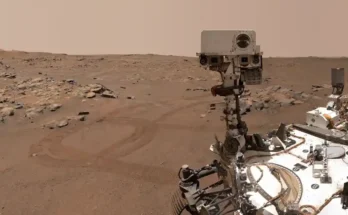
NASA’s Perseverance rover, currently exploring an ancient river delta on Mars, has detected rock features and chemical signals that shouldn’t logically exist in that environment. At least not according to everything we thought we knew.
So the question is simple, and also a little uncomfortable:
What exactly did NASA find on Mars?
Let’s slow down and unpack this, step by step.
The Discovery Didn’t Come From a Crash or Explosion
This wasn’t some dramatic “we found aliens” moment.
No flashing alerts. No emergency press conference.
Instead, the discovery came quietly from a rock sample collected in an area called Neretva Vallis, an ancient river channel that once flowed into Jezero Crater billions of years ago.
Perseverance drilled into a reddish, clay-rich rock formation. The sample looked ordinary at first. But once the rover’s instruments analyzed it… things got weird.
Inside that rock, scientists detected:
-
Organic carbon compounds
-
Strange mineral patterns
-
Tiny structures enriched with iron and sulfur
Now, here’s the problem.
On Earth, those exact combinations often form when microbial life interacts with water and organic material.
But Mars today is dry, cold, and basically hostile to life.
So how did these features get there?

Wait — Does This Mean NASA Found Life on Mars?
Short answer: no.
Long answer: not yet… but something isn’t adding up.
NASA is being very careful with its wording. They’re not claiming life. Not even close. But they are openly saying this is the strongest chemical hint yet that Mars once had conditions that could support microscopic life.
And here’s the unsettling part.
Some of the structures found in the rock resemble what scientists on Earth call biogenic patterns. In plain English, that means shapes and chemical fingerprints commonly created by living organisms.
Now, before anyone jumps to conclusions, scientists also know that non-living processes can sometimes mimic life. Nature is really good at tricking us.
But even with that in mind, researchers admitted something important:
These features are hard to explain using known Martian geology alone.
That’s where the confusion starts.
Why Scientists Didn’t Expect This at All
Mars was supposed to be simpler.
For decades, planetary scientists believed Mars lost its water early in its history, turning into a frozen desert long before complex chemistry could develop.
But the rocks Perseverance is studying tell a different story.
They suggest:
-
Long-lasting liquid water
-
Stable environments
-
Chemical energy sources
-
And possibly repeated cycles of wet and dry conditions
In other words, Mars may have been habitable for much longer than we thought.
And if that’s true, then the old timeline is wrong.
That raises a new question:
If Mars was livable for that long, why don’t we see clearer signs of life everywhere?
Hold onto that thought. We’ll come back to it.
The Tiny “Spots” That Made Scientists Pause
One of the strangest details comes from what scientists casually nicknamed “poppy seed” and “leopard spot” features inside the rock.
These are microscopic specks enriched with iron phosphate and iron sulfide.
On Earth, these minerals often appear when bacteria feed on organic matter in watery environments. The bacteria alter the chemistry, leaving behind very specific mineral fingerprints.
Now, does that mean bacteria were on Mars?
Not necessarily.
But it does mean the conditions required for those reactions existed. And that alone is a big deal.
Because until now, no Mars sample had shown such a clear combination of organic material and reactive minerals in one place.
That’s why NASA scientists called this discovery “the closest we’ve come so far.”
Why NASA Can’t Confirm Anything Yet
Here’s the frustrating part. Perseverance can’t definitively answer the life question.
The rover is smart, but it’s still a robot working with limited tools, millions of miles away.
To know for sure, scientists need to:
-
Examine the rock under powerful microscopes
-
Test isotopes
-
Run advanced chemical analysis
-
Compare results with Earth-based biological samples
And that can only happen on Earth.
NASA’s original plan was to return these samples in the early 2030s. But budget issues pushed that timeline back into the 2040s.
So for now, the samples are sealed in titanium tubes, sitting on Mars, waiting.
Which brings up another uncomfortable question.
What if the most important evidence of life beyond Earth is just… sitting there?
Could This All Be a Geological Trick?
Scientists are openly acknowledging that Mars might be fooling us.
Certain chemical reactions, driven by volcanic heat or groundwater, can produce life-like patterns without biology involved.
And Mars has a long volcanic history.
So yes, there are non-biological explanations. But here’s the key detail:
No single geological process fully explains all the features found in this rock.
It’s not one thing. It’s the combination.
And combinations matter.
What This Means for the Search for Life Beyond Earth
Even if this turns out not to be biological, the discovery still changes everything.
It proves Mars once had:
-
Persistent water
-
Complex chemistry
-
Energy sources
-
Stable environments
That pushes Mars much closer to Earth on the “potential life” scale.
And it also affects how scientists search for life on other planets, like icy moons or distant exoplanets.
If life almost happened on Mars, or started and disappeared, that tells us something profound about how common life might be in the universe.
So… Why Isn’t Everyone Talking About This?
Honestly? Because science moves carefully.
NASA doesn’t do hype. They do evidence.
And right now, the evidence says:
Something unusual happened on ancient Mars — we just don’t know exactly what yet.
That uncertainty might not sound exciting, but in science, it’s huge.
Because unanswered questions are where discoveries begin.
The One Question That Won’t Go Away
Here’s the question scientists keep circling back to:
If Mars had everything life needs, why don’t we see clear proof today?
Did life start and die out quickly?
Did it hide underground?
Or did it never quite cross that final threshold?
For now, the answers are locked inside those tiny rock samples.
And until they come back to Earth, Mars will keep its secret.