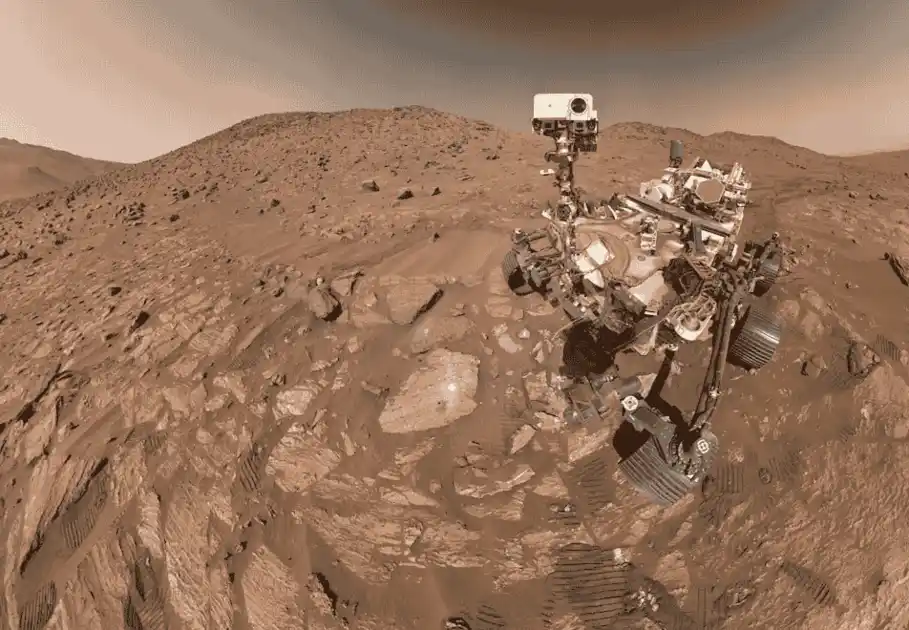
NASA’s Mars Rover Finds Its Strongest Clues Yet of Ancient Life
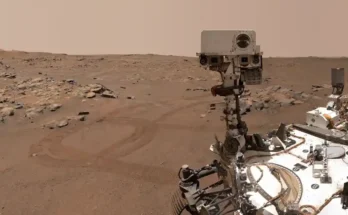
NASA’s Perseverance rover may have uncovered its most promising hint of life on Mars so far. While roaming through what used to be a river channel, the rover drilled into rocks that might hold signs of ancient microscopic organisms.
Now, let’s be clear — this isn’t “proof” of life. Scientists stressed that they’ll need to study the rock samples in labs here on Earth before anyone can draw real conclusions. Still, uh, well, you know what’s crazy? Even NASA’s own science mission chief, Nicky Fox, admitted this is the closest they’ve come to finding signs of ancient life on Mars.
Mars Rock Life 3 of 3
What the Rover Found
Perseverance has been exploring Mars since 2021. It can’t directly detect life, but it does carry drills and sample tubes. The idea is simple: gather material from promising sites, then someday ship it back to Earth for deeper analysis.
The latest sample came from Neretva Vallis, a river channel that once carried water into Jezero Crater. The rock there, called the Bright Angel formation, is made up of reddish, clay-rich mudstones. And here’s the interesting part:
-
The rocks contained organic carbon, which is one of the basic building blocks of life.
-
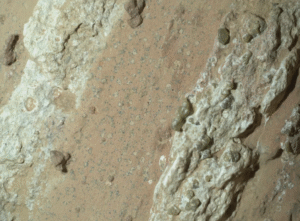
Scientists spotted tiny specks, nicknamed “poppy seeds” and “leopard spots,” filled with iron phosphate and iron sulfide.
-
On Earth, those same chemical patterns often show up when microorganisms munch on organic matter.
So, is that life? Maybe… or maybe not. As Joel Hurowitz from Stony Brook University explained, “Microbes are one possible explanation, but there are also other natural ways these features could have formed.”
Why This Matters
Even if the features turn out not to be biological, this is still the most compelling candidate sample yet in Perseverance’s search. It’s the rover’s 25th sample collected, bringing the total to 30.
As Hurowitz put it: “It would be amazing to prove these features were created by something alive billions of years ago. But even if not, we’re learning how tricky nature can be at fooling us.”
And honestly, that’s part of the excitement. Every rock teaches scientists something new about how Mars might have worked — with or without life.
What Happens Next?
Here’s the catch: those samples aren’t coming to Earth anytime soon. NASA originally hoped to bring them back in the early 2030s. But costs ballooned to nearly $11 billion, pushing the timeline into the 2040s.
Until then, scientists will rely on experiments here on Earth with “stand-in” rocks and simulations. NASA leaders say all options are on the table, including sending advanced lab equipment directly to Mars instead of waiting for retrieval.
Oh, and just in case something happens to Perseverance, the rover already dropped 10 backup sample tubes on the Martian surface — like a little treasure cache waiting to be picked up later.
The Bigger Picture
There’s still no evidence of present-day life on Mars. But for decades, NASA has been chasing signs of ancient water — lakes, rivers, deltas — that could have supported microbes billions of years ago.
This new discovery doesn’t solve the mystery yet, but it feels like a step closer. And, to be honest, that’s what makes space exploration so addictive. Every answer only leads to more questions.
Enjoyed This Mind-Blowing Fact?
If you found this interesting, you’ll love these too:
👉 AI and Jobs: The Godfather’s Warning About Our Future? 👉 Who has 400 IQ?
📺 Also, check out our YouTube Channel – RTS Discovery – for captivating videos on science, history, and the unexplained!


One Comment on “NASA Mars Rover Perseverance Discovers Strongest Evidence Yet of Ancient Life on Mars”